
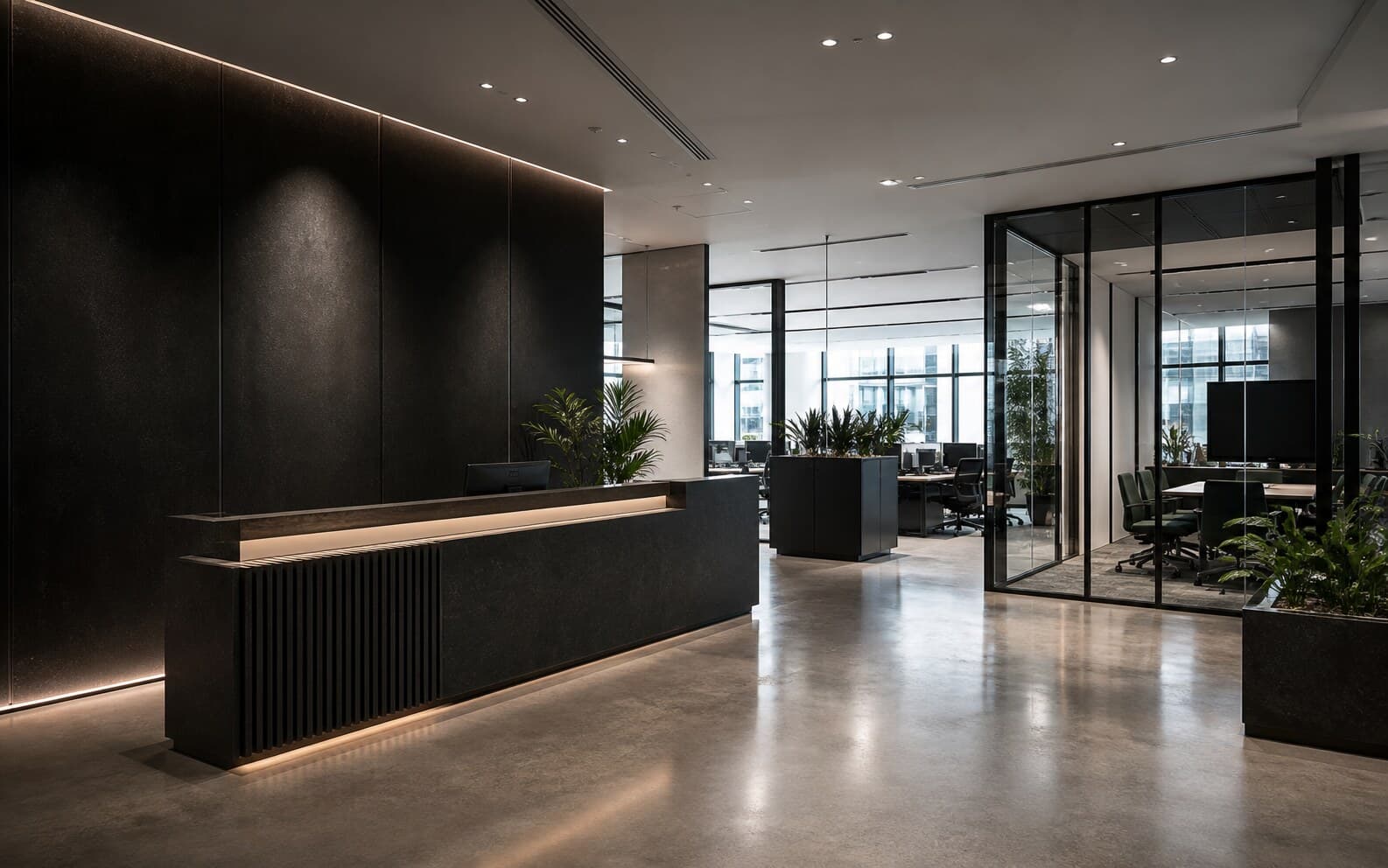
What drives a commercial fitout budget
What a commercial fitout costs comes down to a few things: the state of the tenancy you're starting with, how much demolition or make good is involved, how complex the services are, and the level of finish your business is after.
The biggest single driver is usually how much we build from scratch versus what we can reuse. After that, it's the services behind the finishes — mechanical, electrical, hydraulic, fire, and data — which is where a lot of the money quietly goes.
- Tenancy condition — a bare base-building shell, an old fitout to strip out, or a refurbishment
- Services — air conditioning, power, data, lighting, fire, and any wet areas
- Joinery and partitions — reception, meeting rooms, counters, and built-in storage
- Finishes — flooring, ceilings, glazing, paint, and feature elements
- Program and access — after-hours work, working around your trading, and landlord or centre rules
Indicative cost ranges by space type
We price every fitout on its own, but the ranges below give you a realistic starting point for budgeting a Sydney commercial fitout. They're indicative per-square-metre figures, exclude GST, and move with tenancy condition, services, joinery, and finish level.
Use them to plan, not to quote from. A basic refurbishment can land below the range, and a high-spec or heavily-serviced space can sit well above it.
- Office fitouts — approximately $800 to $1,500 per m²
- Retail and shop fitouts — approximately $1,500 to $3,000 per m²
- Medical and dental fitouts — approximately $1,200 to $2,500 per m²
- Hospitality fitouts — approximately $1,500 to $4,500 per m²
- Make good and de-fit — approximately $300 to $800 per m²
- Commercial joinery — approximately $500 to $2,000 per m²
- Design and construct — approximately $1,000 to $3,000 per m²
Fixed-price versus cost-plus
We deliver most commercial fitouts on a fixed-price contract once the design and finishes are settled, so you have a clear number to work to. Cost-plus or do-and-charge can suit early, unresolved, or fast-moving jobs, but they hand more of the budget risk back to you.
The clearer we can define the work before we price it, the tighter and more competitive that fixed price will be. That's why an early site visit and a clear brief tend to pay for themselves.
How to get an accurate quote
A solid brief lets us price the real work instead of guessing at unknowns. That means fewer assumptions baked into the number, and fewer variations hitting you later.
Bring as much of the following as you can to our first conversation.
- The site address and tenancy plans, or at least the floor area
- Your lease requirements, including any make good or fitout guidelines
- Photos of the current condition
- Your target start date and handover or opening date
- Your equipment, branding, and how you'll actually run the space